
Adding a class to the timetable feels reversible. In practice, it creates an instructor commitment, another room cost, and a new promise to clients.
That makes timing decisions worth testing before they become permanent.
The latest industry data gives studio owners a useful place to look. It does not make the decision for them.
The Signal: More People Are Booking Around Lunch
ClassPass published its 2025 Look Back Report on December 9, 2025. The report is based on millions of reservations made worldwide between January 1 and October 10, 2025.
Reservations between 11 a.m. and 1 p.m. increased 38% globally compared with the previous year. Pilates reservations increased 66%, and the platform recorded more than 15 million Pilates reservations during the period.
For a Pilates or yoga studio, this is a credible reason to question an evening-heavy timetable. It suggests that more ClassPass users are fitting exercise into the working day.
What the Report Cannot Tell You
ClassPass measures activity inside its own marketplace. The report does not provide a studio-level sample, separate reservations from attendance, or show whether the new volume produced repeat clients or profitable classes.
It also cannot account for your neighborhood, your existing client base, local working patterns, instructor availability, pricing, or competing classes nearby.
A 38% global increase is a hypothesis for your timetable. Local repeat demand is the evidence you need before keeping the slot.
Run One Four-Week Test
The following experiment is Mojo's editorial recommendation. It is a practical decision method, not a benchmark validated by ClassPass.
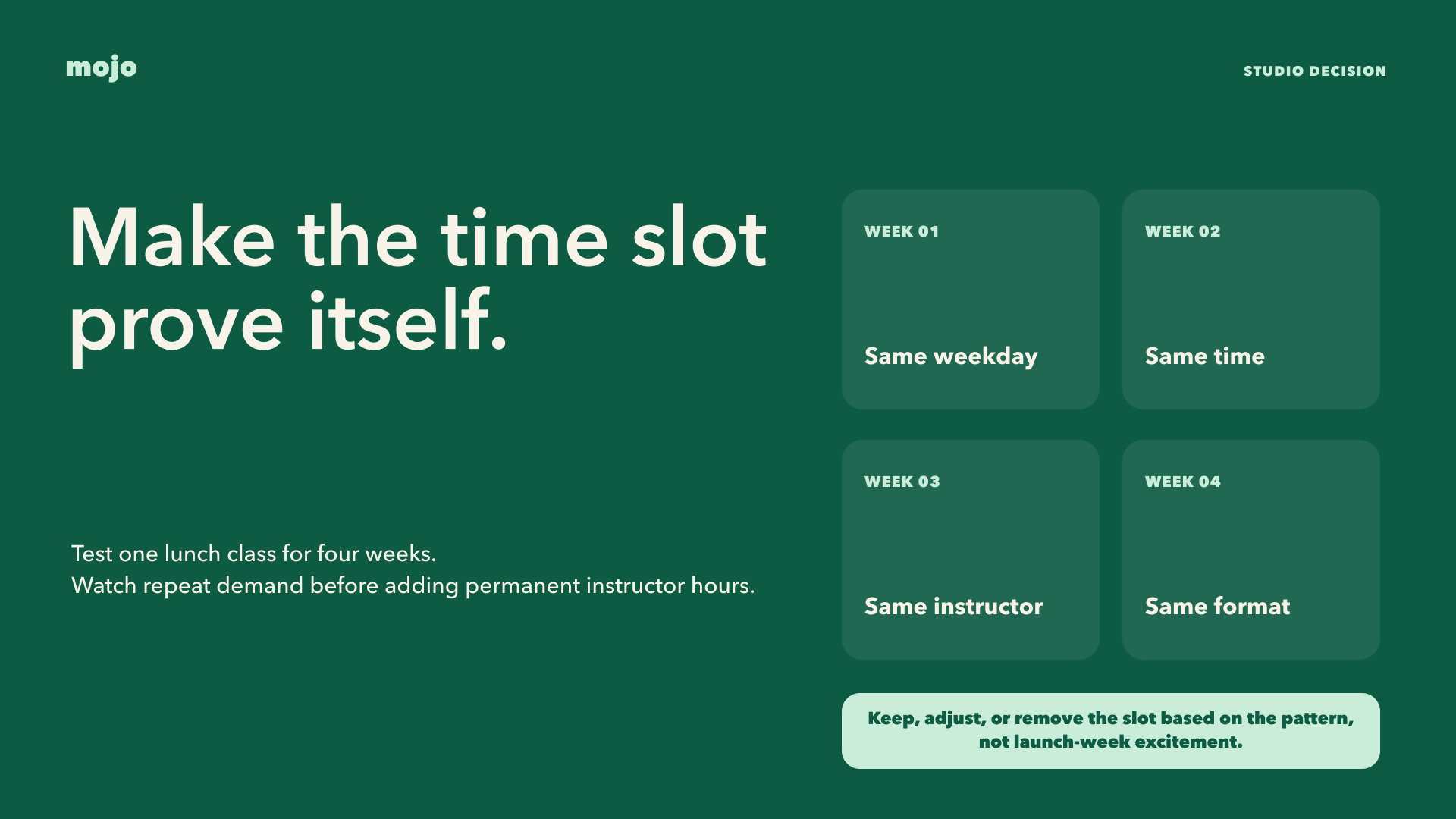
Choose one weekday and one start time between 11 a.m. and 1 p.m. Keep it consistent for four weeks. A Wednesday class at 12:15, for example, gives clients a fair chance to recognize and repeat the routine.
Keep the other important variables as stable as your studio allows:
- same class format
- same instructor
- same capacity and price
- similar promotion each week
If you already schedule through Mojo, recurring class scheduling can hold the weekly pattern while still allowing a one-off exception.
Changing the instructor, class type, and time every week may produce bookings, but you will not know which choice created them.
Announce the test honestly. Tell clients that you are trying the slot for four weeks and will use their bookings and feedback to decide what happens next. A trial creates room to learn without making the timetable feel unreliable.
Measure Four Things
1. Booking fill rate
Divide confirmed bookings by bookable capacity for each class. Look at the pattern across all four weeks rather than celebrating one full launch class.
If the first week fills because of a strong announcement and the next three do not, the slot has not yet shown repeatable demand.
2. Repeat bookings
Count how many participants book the test slot more than once. Repeat bookings tell you whether the time can become part of a client's routine.
Keep this as a simple count when the group is small. A percentage can make a handful of bookings look more conclusive than they are.
3. Cancellations and no-shows
Track cancellations, late cancellations, and no-shows using the definitions your studio already follows. Compare the pattern with a similar class, not with the whole timetable.
Lunch bookings may be sensitive to meetings, commuting days, or childcare. A slot that attracts interest but repeatedly loses clients at the last minute may need a different start time or cancellation policy.
Before changing the policy, use the No-Show Scanner to review reminder timing, booking windows, and capacity as possible sources of attendance risk.
4. Who the class attracts
Separate three useful groups:
- clients who would not otherwise attend that day
- new or recently inactive clients
- regulars moving from another class
A well-filled lunch class can still leave the timetable unchanged if most participants simply move from a healthy morning or evening slot. That may be a good service decision, but it is different from creating new demand.
Use a Keep, Adjust, or Remove Rule
Write the decision rule before the first class. This prevents launch-week enthusiasm from changing the standard later.
Mojo editorial rule
Keep the slot when demand repeats in at least three of the four weeks, cancellations are no worse than a comparable class, and the class is not simply weakening another important slot. Adjust it when interest repeats but the start time, format, or day appears to be getting in the way. Remove it when bookings are mostly one-off or mostly displaced from another class.
The three-of-four rule is an editorial recommendation, not an industry benchmark. A studio with six reformers and a studio with twenty mats will need different commercial thresholds.
Before keeping the class, use the break-even calculator to model what each paid place needs to cover at the attendance level you expect. A popular experiment still needs to make sense for the business.
A Labelled Example
Suppose a 10-place Wednesday class records 8, 7, 8, and 7 confirmed bookings over four weeks. Five clients attend at least twice. Cancellations resemble your Tuesday morning class, and half the participants were not previously attending on Wednesdays.
That pattern supports keeping the slot for another cycle, subject to your revenue floor.
Now suppose the bookings are 9, 4, 3, and 3. Most of the first-week clients return to their usual evening class. That pattern supports removing the lunch slot or changing the test before adding permanent instructor hours.
These examples show the decision method. They are hypothetical and are not customer results.
Keep the Operating Record Together
You can run this experiment with a spreadsheet. The important part is that bookings, capacity, cancellations, and final attendance use the same definitions every week.
Mojo keeps the class schedule, roster, booking states, and final attendance outcomes together. It does not decide whether a lunch class belongs on your timetable. The owner still sets the commercial floor and interprets who the slot is serving.
The report gives you a reason to test lunch. Four weeks of your own studio data gives you a reason to keep, adjust, or remove it.
Run the test without adding another tracking system
Mojo keeps class capacity, bookings, cancellations, and attendance in one operating record while you decide which slots belong on the timetable.
Try Mojo Today