
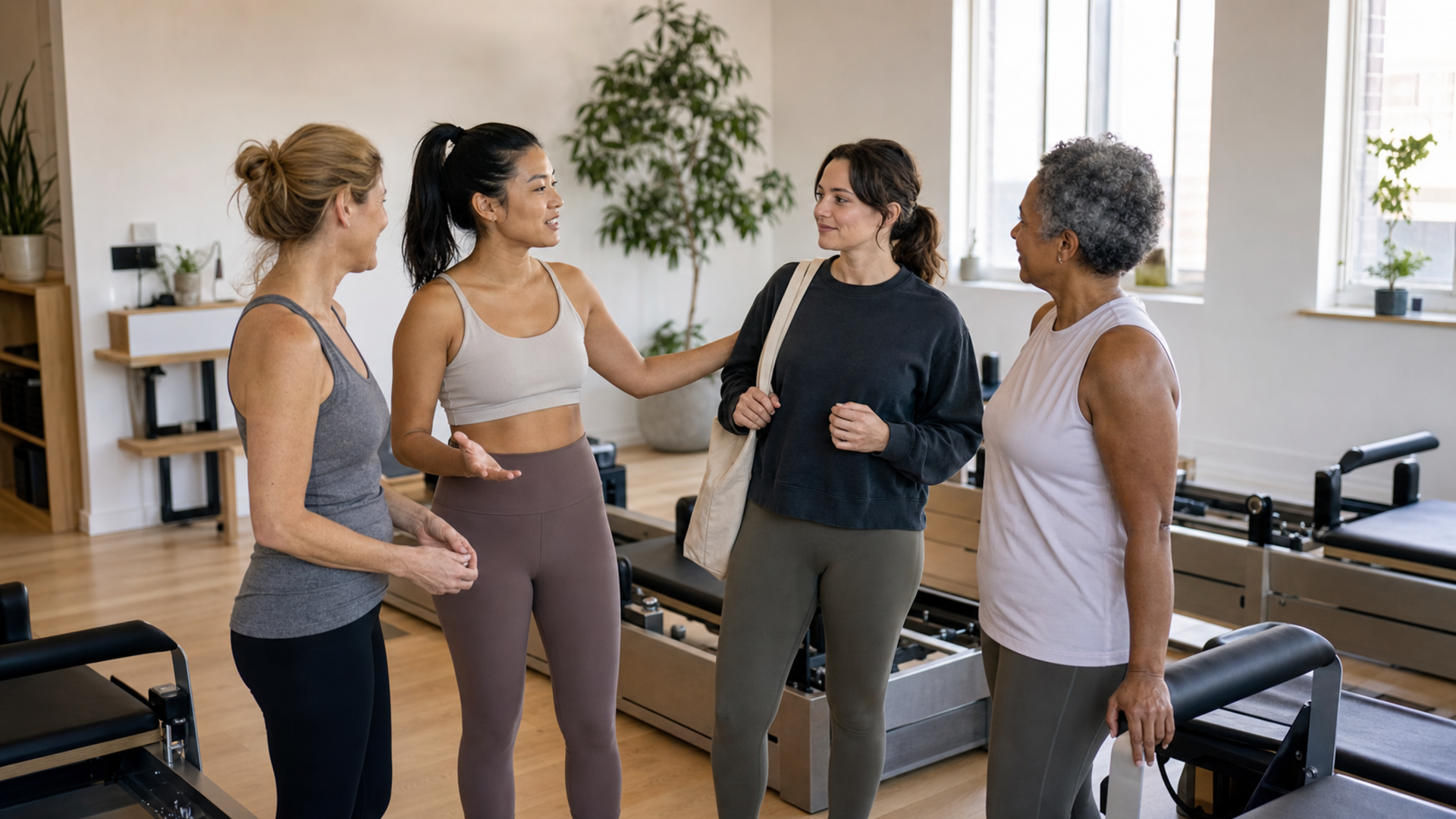
A full class can still feel anonymous.
Clients arrive, take their usual spot, follow the instructor, and leave before they have learned anyone else's name. The workout may be excellent, but the experience gives them little reason to choose your studio over another convenient option next month.
Community changes that equation. When clients recognize the person on the next reformer, expect to see the same instructor on Tuesday, and feel that their absence would be noticed, attending becomes easier to repeat.
For the broader shift behind this behavior, read The Rise of Social Fitness. Here, the focus is practical: how can a boutique studio help real relationships form without forcing them or creating another full-time admin job?
What the 26% Stress Result Really Tells Us
A frequently shared 2017 study of medical students found that participants assigned to a group fitness program reduced perceived stress by 26.2% over 12 weeks. They also reported significant improvements in physical, mental, and emotional quality of life. Students who exercised alone did not show the same significant changes.
That result deserves context. The study was small, nonrandomized, and conducted with medical students rather than paying studio members. It did not prove that group classes improve customer retention.
It does support a useful idea: the setting around exercise can contribute to the benefit. The program gave participants a shared time, a familiar group, and a repeated experience. Those are conditions a studio can design deliberately.
More recent research adds nuance. A 2026 meta-analysis found that group and individual physical activity produced broadly similar health outcomes overall. The group programs that intentionally used group dynamics showed somewhat stronger effects, although the number of studies was limited. Simply putting several people in a room is only the starting point.
Design for Recognition Before Friendship
"Build a community" can sound like a demand for instant friendship. That is too much pressure for a first visit, especially for a client who is new, shy, or unsure of their fitness level.
A better first goal is recognition:
- The instructor knows the client's name.
- A regular offers a natural hello.
- The client understands what will happen next.
- Returning for a second class feels less intimidating than arriving for the first.
Friendship may grow later. Recognition is what makes that growth possible.
A 2026 review of group fitness adherence found that self-efficacy was the most consistent psychological factor associated with continued participation. Social attraction, integration, identity, and supportive instructor behavior also mattered more consistently than a vague sense of group cohesion.
In practical terms, clients need to feel both capable and included.
Use the First Five Minutes Well
Community usually starts before the warm-up.
Give instructors a simple arrival routine that fits their personality:
- Greet each client by name.
- Introduce a newcomer to one nearby regular, with a useful point of connection.
- Mention what the class will focus on so nobody feels behind.
For example: "Ana, this is Mara. You are both rebuilding after a break, so I will show you the same spring option today."
That is more helpful than asking a newcomer to introduce themselves to the entire room. It creates one low-pressure connection and reassures both clients that adaptations are normal.
The instructor does not need to perform as an event host. They only need a repeatable way to make the room easier to enter.
Protect Recurring Overlap
Relationships need repetition.
If the timetable changes constantly, clients may keep attending without seeing the same people often enough to become familiar. Protect a few stable instructor-and-timeslot combinations, especially where rebooking is already strong.
Recurring group sessions help clients build a weekly rhythm. Over time, "Tuesday at 6" becomes more than an opening in the schedule. It becomes the class where they know how the instructor teaches and who usually takes the reformer beside them.
You can strengthen that rhythm without creating exclusive cliques:
- Let instructors mention who is returning from the previous week.
- Celebrate consistency without ranking clients.
- Keep one or two places available for new or occasional visitors.
- Brief regulars to help newcomers with small practical details.
The goal is a familiar room with an open door.
Make Progress Visible Without a Leaderboard
Competition can increase short-term activity in some settings. One 11-week randomized trial found much higher attendance in social-comparison conditions than in individual controls. But its participants were university students in an online incentive network, not long-term members of a boutique studio.
A public leaderboard can energize confident regulars while making beginners, older clients, or clients returning from injury feel exposed. Before adding competition, ask what behavior it rewards and who may quietly opt out.
Shared progress is often a better fit:
- Complete eight classes together during a month.
- Fill a board with mobility wins contributed by the whole group.
- Run a charity class where attendance unlocks the studio's donation.
- Set a collective consistency target with several ways to participate.
If you do use individual challenges, reward attendance, curiosity, or personal improvement rather than raw performance. A client should be able to succeed without beating somebody else.
Give Partner Work a Purpose
Partner exercises work best when the interaction helps the movement.
Try:
- Two clients checking each other's alignment from a cue card.
- Alternating stations with a clear handoff.
- A short balance exercise where each person offers light support.
- Paired reflection at the end: one movement that felt better today.
Always offer an easy solo option. Some clients come to class for quiet, privacy, or recovery from a socially demanding day. Community feels safer when participation has room for choice.
Tell Stories About Belonging
Studios often celebrate the most dramatic transformation. That can inspire people, but it can also imply that only exceptional outcomes deserve attention.
Make room for smaller stories:
- The client who returned consistently after a difficult month.
- Two members who met in class and now book together.
- The beginner who stopped hiding at the back.
- The group that welcomed a new parent into a more flexible routine.
Ask permission before sharing names, photos, health details, or personal circumstances. Then connect the story to a behavior another client can imagine: showing up, asking for an adaptation, booking again, or encouraging somebody nearby.
These stories teach members what your studio values.
Extend the Connection Beyond Class
Community does not require a large event calendar. Start with one extension that matches how your clients already behave:
- Ten minutes for coffee after the Saturday class.
- A monthly beginner session followed by open questions.
- A small WhatsApp or online group with clear expectations.
- A quarterly walk, workshop, or member breakfast.
Keep online spaces useful. Share schedule changes, celebrate member-approved wins, answer practical questions, and invite clients to upcoming sessions. Avoid turning the group into a constant sales channel or expecting instructors to moderate it at all hours.
In Mindbody's 2025 operator survey, personalized outreach was the most frequently reported retention tactic, while engagement events were also common. The lesson for a small studio is not to organize more for the sake of activity. It is to create a few moments in which clients feel remembered.
Make the Community Easy to Enter
A close group can look unwelcoming from the outside. Regulars share jokes, know the equipment, and move through familiar routines while a newcomer is still wondering where to leave their shoes.
Review the first visit from that newcomer's perspective:
- Does the booking confirmation explain what to bring and when to arrive?
- Does somebody greet them before they have to ask for help?
- Does the instructor explain studio-specific language?
- Is there a natural invitation to return?
One sentence can do a great deal: "Most people in this class started as beginners, and I will give you options throughout."
Community should reduce the risk of joining, not raise it.
Measure Whether Connection Changes Behavior
You do not need a "community score." Track the behaviors that connection should make easier:
- How many first-time clients book a second visit within 14 days?
- How many clients return to the same class or instructor?
- Are members attending more consistently after a group challenge?
- How many new clients come through member referrals?
- Which classes retain clients at 30, 60, and 90 days?
Add qualitative signals too. Are clients arriving a little earlier? Do they greet one another without prompting? Does a regular help a newcomer find equipment? Those moments explain the numbers and reveal whether the atmosphere feels natural.
Avoid claiming that friendship alone caused better retention. Pricing, instruction quality, schedule fit, and life changes still matter. The useful question is whether your class design is making the next visit easier to choose.
Run a Four-Week Community Experiment
Choose one recurring class and keep the experiment small:
Week 1: Ask the instructor to greet every client by name and make one thoughtful introduction.
Week 2: Add a shared, noncompetitive consistency goal.
Week 3: Invite the group to one optional ten-minute social moment after class.
Week 4: Review rebooking, attendance, and short client feedback with the instructor.
Keep what felt natural. Remove what felt forced. Then repeat the useful pieces in another class.
The strongest studio community is rarely the loudest. It is the one where people feel noticed, capable, and welcome to return.
Give clients a schedule they can return to
Mojo helps boutique studios publish recurring classes, manage bookings, and keep attendance in one place.
Try Mojo Today